
ChaNGA Unleashed: Unprecedented Simulations of Galaxy Formation
Overview
Understanding the formation of galaxies like our own Milky Way, and the tiny dwarf galaxies around it, is key to furthering our understanding of how cosmic structures formed and the nature of dark matter and black holes. To follow the formation of even one galaxy over the lifetime of the universe requires an accurate physical model that includes many different processes which act on both large and small scales. A new code, ChaNGA, is being run on NASA high-performance computers to produce realistic galaxy simulations that capture gravity and gas hydrodynamics, and describe how stars form and die and how black holes evolve. The simulations resolve galaxy structures at unprecedented resolution—down to several hundred light years (about 100 parsecs). Simulation results are being used to interpret observations gathered by NASA missions, such as the Hubble Space Telescope, to further NASA's goal in astrophysics: "Discover how the universe works, explore how it began and evolved, and search for life on planets around other stars."
Project Details

ChaNGA (Charm N-body GrAvity solver), was developed at the University of Washington and the University of Illinois to perform N-body plus hydrodynamics simulations. A unique load-balancing scheme, based on the CHARM runtime system, allows us to obtain good performance on massively parallel systems such as Pleiades supercomputer located at NASA's Ames Research Center. On Pleiades, we are running high-fidelity simulations of dozens of individual galaxies, spanning from the mass of the Milky Way down to those 1,000 times less massive, with force resolutions under 100 parsec (1 parsec = 3.26 light years). Examples of ongoing projects with these simulations include: quantifying the redistribution of matter in galaxies when supernova energy is deposited; exploring the growth of black holes and the impact of active galactic nuclei (AGN) on galaxy evolution; and determining whether the ultraviolet light from stars in galaxies can "escape" to re-ionize the universe.
Results and Impact
The high-resolution simulations already produced by our collaboration have revolutionized scientists' view of galaxy formation. We have discovered that when supernovae occur in the high-density regions where stars are born, their energy can be transferred to dark matter, pushing the dark matter out of the center of galaxies. This process cannot occur in lower-resolution simulations, and thus evaded detection for over a decade, despite other attempts to produce realistic galaxy simulations. These new results explain several long-standing observational challenges to Lambda Cold Dark Matter (CDM) galaxy formation theory, and open new paths of inquiry.
Why HPC Matters
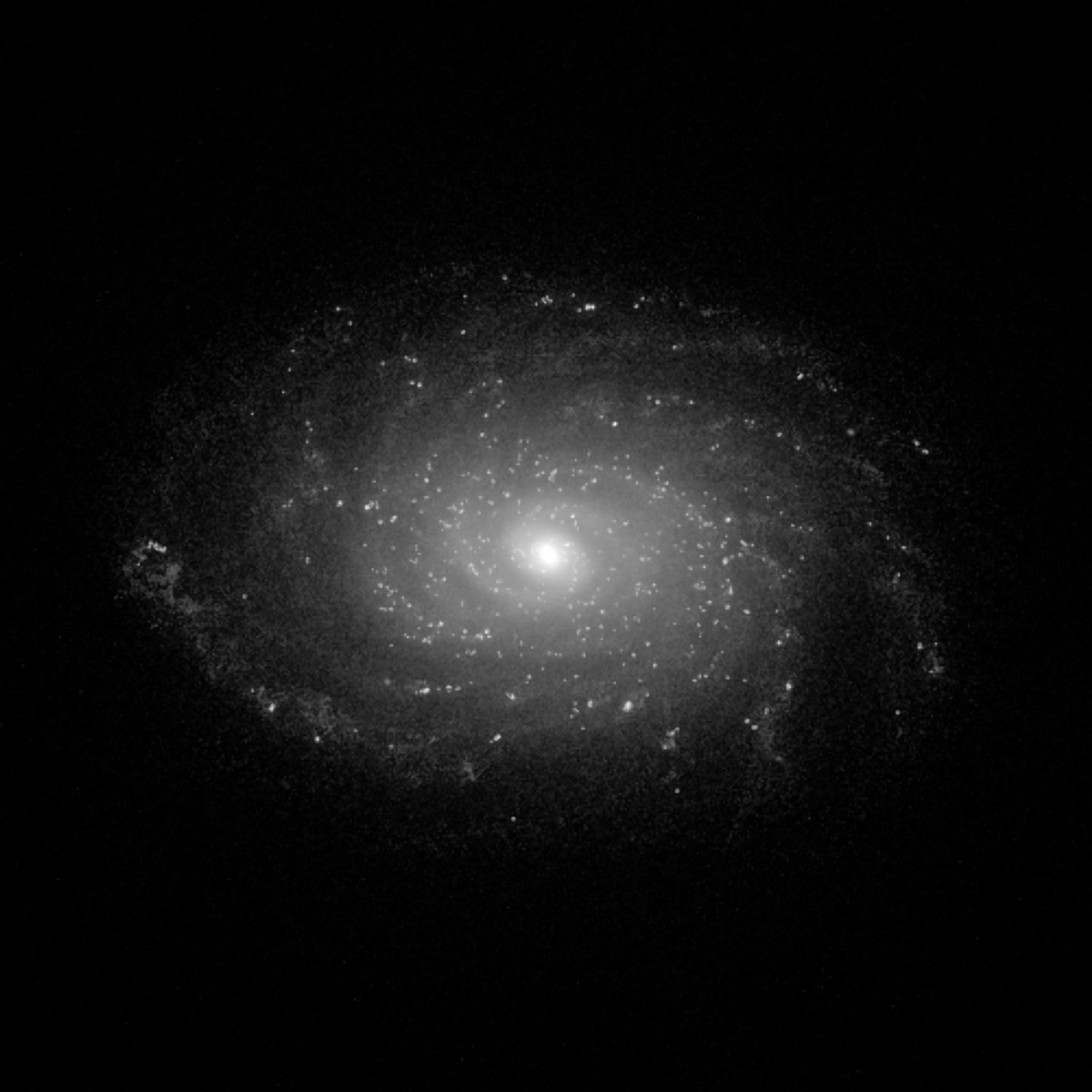
Achieving the high-resolution simulations that have revolutionized our theory of galaxy formation requires billions of particles in a given simulation, and the high-density regions where stars form require small time steps. A single galaxy simulation can take up to 1 million processor hours. Our newly updated version of ChaNGA allows us to scale to hundreds of thousands of cores. Tests performed on Pleiades have produced science-ready galaxy simulations, and more state-of-the-art simulations will be run on Pleiades over the next year.
Maureen Teyssier, Rutgers Universitymteyssier@physics.rutgers.edu Fabio Governato, The University of Washington
fabio@astro.washington.edu
More Media
See additional videos related to this demo in our media gallery.