
NAS Science Gives the Gift of Insight in 2023
These 19 fabulous projects led by the NAS Division’s gifted scientists and engineering gurus are making things safer for Earthlings and future human and robotic space explorers! All were showcased at SC23—the International Conference for High-Performance Computing, Networking, Storage, and Analysis—in Denver, Colorado this November, where attendees from around the world flocked to see science and engineering advances made possible by NASA high-performance computing.
Advancing Aircraft Simulation

New approaches to simulating designs for safer, quieter, and more fuel-efficient aircraft are taking flight, with the help of NAS Division experts and supercomputers.
Automated Voronoi Meshing for High-Fidelity Aerodynamic Simulations
NAS computational fluid dynamics experts have been working with teams across the agency to predict how exhaust from rockets generates shock waves around the launch structure.
Computational Study of a Small Ducted Propeller
To help design next-generation vertical lift vehicles like air taxis or large cargo transports, researchers at NAS simulated the physics around a multi-rotor tilt-duct concept vehicle that is capable of vertical and forward flight.
Modeling Aerodynamic and Acoustic Fields Around Turbofan Engines
A team of NAS researchers implemented a novel approach to an in-house modeling tool to reduce the computational cost of time-accurate simulations for an airbreathing turbofan jet engine.
Scale-Resolving Methods for Jet Aeroacoustic Predictions
As part of the ongoing design and planning work for NASA’s Low Boom Flight Demonstrator, research scientists at NAS developed high fidelity simulations to predict jet noise, which lead to new insights for future supersonic configurations and future FAA guidelines.
Simulating Air Taxi Safety: NASA’s Quadcopter in Ground Effect
To support NASA’s development of safe and efficient urban air mobility vehicles, aerospace engineers at NAS performed simulations of rotors and air taxis to better characterize the vehicle aerodynamics close to the ground.
Simulating an Iced Wing for Aerodynamic Performance Predictions
The Launch Ascent and Vehicle Analysis (LAVA) team at NAS showed that scale-resolving methods can provide accurate aerodynamic data for dangerous ice buildup on aircraft wings, which will needed for future aircraft design and certification.
Supporting Safety in Space
For NASA, it’s all about safety, and NAS Division experts continuously work to develop new tools and methods to help ensure that future space missions go off without a hitch.

Launch Pad Rocket Plume Simulations Supporting NASA’s Artemis Missions
To support the agency’s Artemis missions, the LAVA team performed simulations for predicting exhaust plume impingements to improve understanding and safety for future launches at Kennedy Space Center.
NASA’s Use of Supercomputing in the Artemis Program
Thousands of computational fluid dynamics simulations, run on supercomputers at the NAS facility, were used to provide mission planners an unprecedented amount of data to make decisions about safety for Artemis missions.
Simulating Supersonic Parachute Inflation for Atmospheric Entry
The LAVA team developed the capability to simulate supersonic parachutes during inflation to better understand and predict their behavior. Their tools will be used to inform future work for upcoming interplanetary robotic missions to Mars, Venus, and Titan.
Bringing Science Down to Earth (and Over Our Heads)
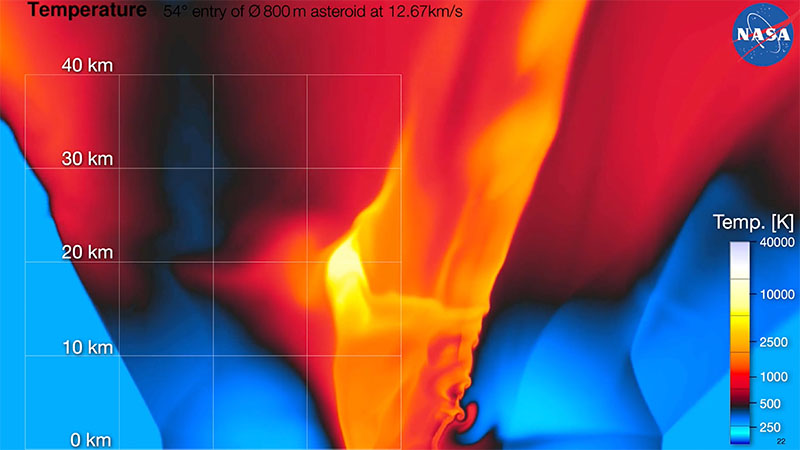
Asteroid, smash-teroid! NAS researchers are deeply involved in modeling and simulation of hypothetical asteroid impact scenarios to help assess risks and develop ways to protect Earth. They’ve also set their sights on finding Earth-like planets and understanding storms on the Sun that can affect our daily lives.
Finding Fireballs Hidden in Satellite Lightning Data
Using the Aitken supercomputer and a custom data pipeline, NAS Division visualization specialists teamed up with SETI researchers to identify exploding meteors in Earth’s atmosphere mixed in with lightning strike observations.
High-Fidelity Blast Wave Modeling of Large Asteroid Impacts
NAS researchers ran simulations of blast wave formation from the entry and impact of a large, imaginary asteroid, as part of an exercise for an international conference on planetary defense.
Parallel Mesh Adaptation for Unsteady Asteroid Blast Simulations
Research scientists at NAS developed an efficient approach to simulate a full-scale, 3D asteroid entry with a 50-megaton airburst and blast propagation in a heavy atmosphere.
Simulating Kilometer-Size Asteroid Impacts on Earth
Using supercomputer simulations of hypothetical kilometer- or mile-wide-size asteroids, scientists at NAS sought to understand the effects of impacts on Earth and improve the accuracy of their predictions.
How to Find a Signal from Earth-Like Planets in Stellar Noise
Running on NAS supercomputers, researchers modeled disturbances on solar-type stars—called stellar jitter—to help astronomers identify exoplanets similar to Earth from observational data.
Predicting the Appearance of Sunspots on the Solar Surface Using Machine Learning
Scientists at NAS developed machine learning-driven technology to enable an early warning system for solar storms that can impact space exploration, near-Earth activities, and human health.
Pushing the Envelope
NAS systems and services experts continually make improvements to our high performance computing tools and technologies! Among their 2023 accomplishments, teams developed machine learning and artificial intelligence methods to helps NAS users to advance their research; created an automated approach for rapid development of aerodynamic databases for the Artemis program; continued operating a more sustainable computing environment via the energy-efficient Modular Supercomputing Facility; and built an application that makes it simple and easy to develop and run data analysis pipelines on NAS systems. Check them out:
- Artificial Intelligence/Machine Learning in HPC Environments
- Machine Learning to Detect Convergence for Space Launch System CFD Simulations
- Toward Energy Efficient High-End Computing
- Ziggy: A Powerful New Tool for Data Analysis Pipeline Management
From everyone in the NAS Division, we wish you a safe, warm rest-of-the year and a great start to 2024!
—Jill Dunbar and Katharine Pitta, NASA Ames Research Center
See all of NASA’s science and engineering demonstrations presented at SC23 by visiting: http://www.nas.nasa.gov/SC23/
