
Piyush Mehrotra
Former Division Chief (Retired)
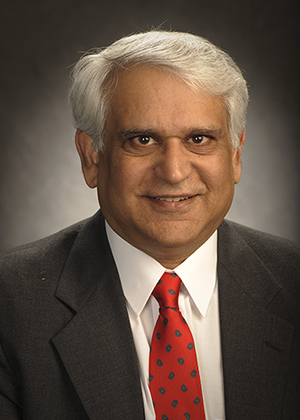
As chief of the NASA Advanced Supercomputing (NAS) Division, Piyush Mehrotra oversaw the full range of high-performance computing services for NASA's primary supercomputing center. He also managed NAS's modeling and simulation research and development efforts, which are critical for numerous agency missions. Mehrotra's key responsibilities included setting high-level objectives for the division, creating and maintaining a productive, high-impact computational facility, and coordinating technical strategy with both Ames and NASA Headquarters management. This work encompassed managing about 200 research and development (R&D) scientists, engineers, and support staff comprised of civil servants and contractors.
Mehrotra is a world-renowned expert with over 40 years of R&D experience in parallel programming languages, compilers, and runtime systems for shared- and distributed-memory systems, and middleware infrastructure for grid environments. He is also experienced in performance characterization and benchmarking of parallel architectures. He is currently focusing on hybrid computing infrastructure, which includes both on-premise supercomputing and commercial cloud resources to support complex workflows for near-real time analysis of observational data. He has published over 100 articles in journals and conferences, edited two books, and served as editor for several issues of international computer science journals.
Previously, Mehrotra served as chief of the NAS Computational Technologies Branch and lead of the Application Performance and Productivity (APP) Group. He has held various other technical and managerial positions since joining NASA Ames Research Center in 2000. During this time, he has received several NASA awards including the Outstanding Leadership Medal in 2010 and 2021, along with several group achievement awards. Previously, he was an assistant professor in Purdue University's Computer Science Department and rose through the ranks at ICASE, the Institute for Computer Applications in Science and Engineering, to become a Research Fellow, managing their computer science program. He obtained his Ph.D. in Computer Science from the University of Virginia in 1982.
Please enable Javascript to see email address.