
GRAIL Gravity Maps Enable Insights into Moon's Crust and Interior
Overview

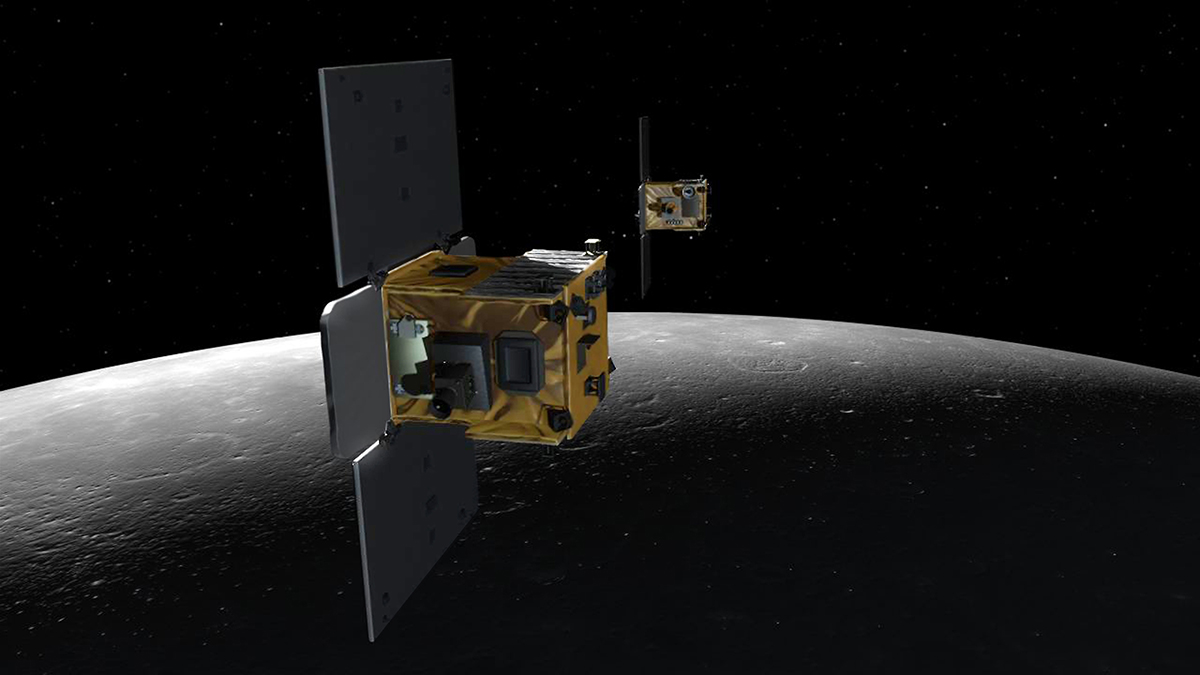
Although the Gravity Recovery and Interior Laboratory's (GRAIL) twin Ebb and Flow spacecraft orbited the Moon at 3,600 miles per hour, their instruments made precise measurements of slight changes in distance between the spacecraft, caused by differences in the lunar gravity field underneath.
Using these measurements, GRAIL researchers are producing the highest-resolution satellite-based gravity maps of any planet or natural satellite. Because variations in lunar gravity are caused both by visible features, such as mountains and craters, and by masses hidden beneath the lunar surface, these gravity maps are divulging unprecedented detail about the Moon's crust and interior.
Project Details
Researchers use the 7 million tracking observations between GRAIL's two spacecraft to calculate precise spacecraft orbits and geodetic characteristics of the Moon. Then the GRAIL team makes successive runs of gravity field models, using increasing degree and order of spherical harmonics, to estimate errors and refine parameters for subsequent runs. The recent GRGM900C gravity maps resolve 6-km spatial blocks at the Moon's equator, with even higher resolution at the poles.
Results and Impact
High-resolution GRAIL gravity maps show very strong correlation with topography measured by the Lunar Orbiter Laser Altimeter instrument on NASA's Lunar Reconnaissance Orbiter, with differences between the two revealing subsurface details. Combining high-resolution GRAIL gravity maps with other techniques, researchers have discovered the following:
- The Moon's crust is less dense and more porous and fractured than previously thought.
- Gravity anomalies from GRAIL maps reveal that the outline of the dark volcanic Oceanus Procellarum on the near side is bounded by a rectangular formation of lava-flooded rift valleys not visible on the Moon's surface.
- While the Moon's near side experienced the same asteroid bombardment as the far side, it developed very different features because the near side crust was hotter and thinner at the time of the impacts.
Why HPC Matters
Using spherical harmonic functions of degree and order 900, GRAIL's models consume 4,080 processor cores and 6 terabytes of memory on the NASA Center for Climate Simulation's (NCCS) Discover supercomputer. Completing the iterations for one map takes several months. More than 4 million processor-hours were consumed by the GRAIL runs, culminating in the complete degree-900 lunar gravity map. Among other support, the NCCS has assisted by fine-tuning the team's software code, expediting job execution, and providing separate disk nodes optimized for maximum input/output speeds.
What's Next
Analysis of current results indicates researchers have not exhausted the detail present in the observations, and the GRAIL team is preparing higher-resolution runs to fully extract the gravity information inherent in GRAIL tracking data.
Ellen Salmon, NASA Goddard Space Flight Centerellen.m.salmon@nasa.gov Sander Goossens, NASA Goddard Space Flight Center
sander.j.goossens@nasa.gov Frank Lemoine, NASA Goddard Space Flight Center
frank.g.lemoine@nasa.gov