
Astrophysics – New Simulations Explore the Origins of Star Clusters
Scientists from the University of California, Berkeley, and Lawrence Livermore National Laboratory are running highly complex simulations on the Pleiades supercomputer to study the origins of star clusters and massive stars, with masses 10 - 100 times greater than our Sun. Spanning over 700,000 years, the simulations follow the gravitational collapse of giant molecular clouds into turbulent clumps that further collapse into star-forming cores, ultimately condensing into star clusters. Using realistic initial conditions derived from various observations, the simulations incorporate a broad range of physical processes including gravity, supersonic turbulence, hydrodynamics, radiation, magnetic fields, chemistry, and highly energetic outflows, in addition to managing immense scales of time and space. The simulation results are bringing researchers closer to understanding how star clusters and high-mass stars are formed—one of the most fundamental unsolved problems in astrophysics.
Our ability to run increasingly complex supercomputer simulations, together with the extraordinary data obtained by space-based observatories like Hubble, is allowing us to discover the fundamental processes that shape the galaxy.
Richard Klein, astrophysicist, University of California, Berkeley and Lawrence Livermore National Laboratory
Quick Facts
- The large-scale radiation-magnetohydrodynamics simulations are run on NASA's Pleiades supercomputer using an advanced, 3D adaptive mesh refinement code called ORION2, which was developed specifically for the study of astrophysical phenomena.
- Each simulation required 1,000 – 4,000 processors on Pleiades. In total, the simulations ran for more than 6 million processor-hours over several months, and produced about 100 terabytes of data.
- The simulations show that massive, giant infrared dark cloud filaments—equivalent to 660 solar masses and spanning 5 parsecs—form by gravitational collapse in a strongly magnetized, highly supersonic chaotic turbulent environment. The filaments collide, accreting gas that condenses into protostars and protostellar clusters.
- The full 3D dataset generated from the simulations provides the entire evolution of the formation of these protostars. At the end of 700,000-year span, the number, stellar distribution, and properties of the magnetized clumps and the protostellar systems match well with data from several space-based observatories.
Key Image
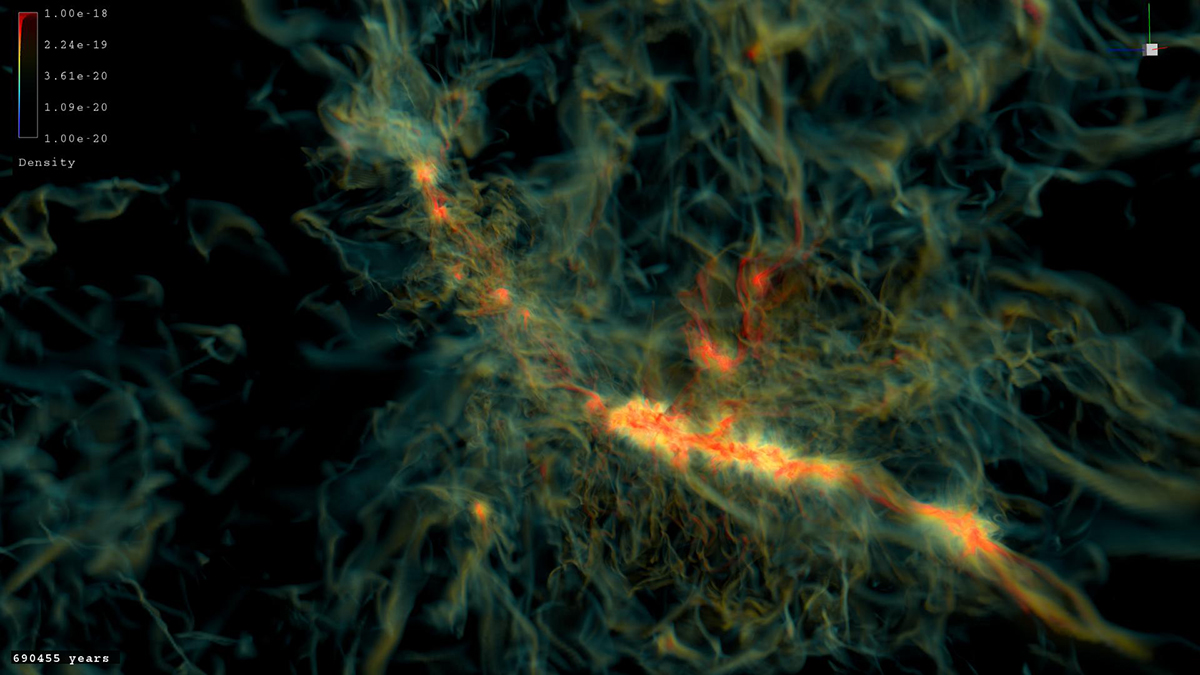
Image Caption
An infrared dark cloud (IRDC) in a simulation generated by the ORION2 code shows a complex, turbulent, braided filamentary structure after nearly 700,000 years in its evolution, when protostars have begun to form deep within the structure. The protostars are seen by the bright luminosity they emit along the main and surrounding filaments. The collision region of the main filament with a nearby dark cloud produces multiple stars, resulting in a protostellar cluster. David Ellsworth, Tim Sandstrom, NASA/AmesDownload High-Res Image
Contacts
Richard Klein, University of California, Berkeley; Lawrence Livermore National Laboratoryrklein@astron.berkeley.edu