
Helping Keep Astronauts Safe with Advanced Simulations, Visualizations
Think back on your favorite movies about astronauts and space travel: The dramatic launch countdown, the billowing plumes and flames as the rocket engines fire up and the vehicle lifts off, the rumble and roar inside the crew capsule. In real life, research scientists in the NASA Advanced Supercomputing (NAS) Division are producing highly detailed simulations and visualizations to help keep astronauts safe during takeoff of NASA’s Orion multi-purpose crew vehicle, which will transport humans to interplanetary destinations such as the moon and eventually Mars and return them safely back to Earth.
The NAS scientists’ cutting-edge simulation techniques are being used to predict vibrations on the Orion spacecraft’s launch abort vehicle—part of the Orion Launch Abort System (LAS), designed to carry the crew away from the spacecraft if a problem occurs on the launch pad after ignition or during ascent. The flow simulations of Orion’s pad abort and ascent abort scenarios, run on the Pleiades supercomputer, are directly impacting the spacecraft’s design to increase astronaut safety and reduce uncertainty while keeping cost and launch abort vehicle weight down.
"This is one of the first times where large eddy simulation (LES) techniques have been used in full-scale spacecraft analysis and design at NASA,” said Francois Cadieux, a research scientist in the NAS Computational Aerosciences Branch. “I’m excited to play a part in the agency’s next big human space exploration project—this work brings LES to a point where it can provide accurate predictions within a short enough turnaround time to guide Orion’s design." Previously, the use of such high-fidelity tools has been limited in industry, and has otherwise been relegated mostly to academic research.Pleiades is absolutely essential for running these large-scale simulations, storing the data, and post-processing the data to deliver meaningful data products.
With the help of LAVA developer Michael Barad, Cadieux produced a variety of turbulence-resolving computational fluid dynamics (CFD) simulations using the NAS Divison’s in-house developed Launch Ascent and Vehicle Aerodynamics (LAVA) software. NAS visualization experts then helped the researchers identify different types of vortices, which are often a source of noise and vibration on space vehicles.
350-Million Degrees of Freedom
In order to predict the flow physics around the launch abort vehicle, Navier-Stokes equations are solved on a set of 350 million adjoining cubes—ranging in size from centimeters to meters—covering every square inch of the vehicle and its immediate surroundings. The location of these cubes is adapted as the simulation progresses, in order to continually cluster them in critical regions where vortices and pressure waves are present. "Using automated, cube-based adaption enables ultra-high performance simulation of flows past complex objects, with minimal user effort," said Barad. Cadieux produced such simulations of the Orion abort motor ground test (Qualification Motor 1, or QM-1) and three launch abort scenarios.
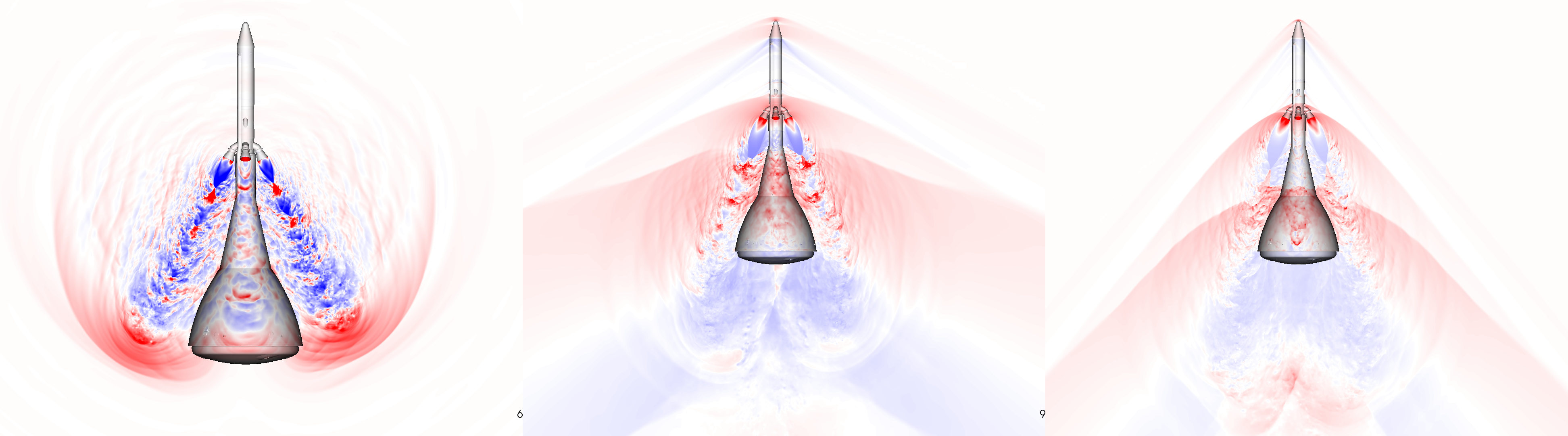
The QM-1 and LAS pad abort simulation results helped NASA engineers understand how the vibration levels change when taking into account the surface of the crew vehicle, which was absent in the ground test, but present in the LAS simulation. The transonic and supersonic launch abort simulations then provided insight into how the locations of maximum transient (short-duration) and vibrational loads change, and how the vibrations are reduced over much of the vehicle as its velocity and altitude increase.
Cadieux’s simulations predicted a maximum transient load for the QM-1 test that closely matched experiments, and the simulated vibrational loads agreed within 2% of measured vibrations. These results have given engineers confidence in LAVA’s capability to accurately simulate the complex physics at play during launch abort scenarios.
The Importance of Supercomputers
Cadieux’s simulations consumed close to 2.5 million hours of processing time on the Pleiades supercomputer over the past year, and produced about 700 terabytes—700 trillion bytes of data—saved on storage systems at the NAS facility.
“Pleiades is absolutely essential for running these large-scale simulations, storing the data, and post-processing the data to deliver meaningful data products,” said Computational Aerosciences Branch Chief, Cetin Kiris, who oversees NAS Division aeronautics and aerospace CFD research efforts and conceived the LAVA framework.
“It’s critical that the launch vehicle is designed to withstand the worst possible scenario, and the LAVA simulations run on Pleiades help us to accurately predict and understand how the vibrational levels change when we include the surface of the crew vehicle, and help design engineers shape the final vehicle design,” added Kiris.
Visualizations Enhance Understanding
Using Cadieux’s simulation data, NAS visualization experts created a series of high-quality images and movies revealing new flow details that further enhanced the scientists’ understanding of the flow dynamics in the launch abort motor plumes.
“From these visualizations, we were able to identify areas of high vibrational loads on the vehicle, and their sources,” said Cadieux. “What we learned is that noise coming from the turbulence of the plume is substantially higher than any noise generated from its interaction with attached shockwaves.”
NAS staff continue to run simulations and visualizations of launch abort scenarios at varying angles of attack—most recently, using data from a test conducted in the 11-by 11-ft. Unitary Plan Wind Tunnel at NASA Ames.
“We’re still asking lots of questions,” said Cadieux. “Like, how do the loads on the LAV surface change at higher angles of attack? How do we best use data from wind tunnel tests to predict loads for actual flight conditions where the vehicle is accelerating?" The answers will be used in the next series of ground tests, crew mockup tests, and critical flight tests to prepare for the real deal—the first crewed Orion flight currently scheduled for launch by 2023.
—Jill Dunbar, NASA/Ames Research Center
Simulation work was done in collaboration with and supported by the NASA Orion Loads and Dynamics team, led by Quyen Jones, and vibro-acoustics experts Jayanta Panda, Vincent Fogt, and Kenneth Fiorelli. NASA interfaces with Lockheed Martin, the prime contractor for the design of the Orion spacecraft and its launch abort system. Data on the abort motors was provided by its design team at Orbital ATK.
