
Simulations Put a New Spin on Wind Tunnel Tests
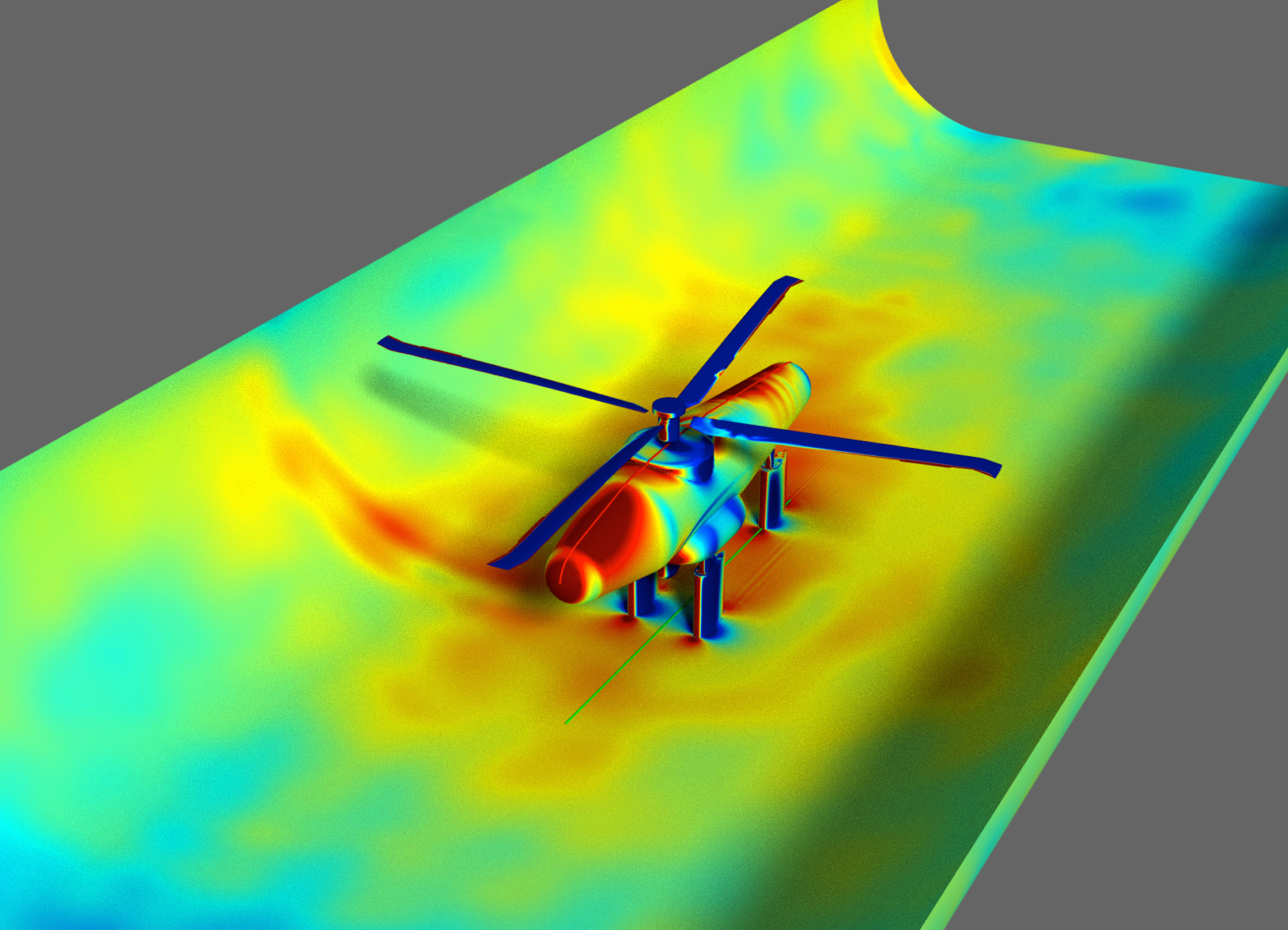
Helicopters and tiltrotor aircraft are called into action every day to provide valuable services ranging from emergency medical services, to rescuing military personnel, to monitoring commuter traffic. To help design safer, quieter, and more efficient rotorcraft, scientists at NASA’s Ames Research Center are performing high-fidelity simulations on the Pleiades supercomputer.
Simulating the complicated aerodynamics of spinning rotors is a challenging task, as moving blade tips generate vortices that interact with each other and with vehicle components, creating very complex flow fields. Investigators Neal Chaderjian and Jasim Ahmad in the NASA Advanced Supercomputing (NAS) Division at Ames are working with the agency’s Rotary Wing Project to develop advanced computational methods that can help design engineers better understand these airflow interactions.
Typically, scientists validate their methods by comparing simulation results with wind tunnel and flight test measurements. Because of recent improvements in simulation resolution and accuracy achieved by Chaderjian and Ahmad, validating modern computational methods now requires more accurate tests of key performance parameters, such as the figure-of-merit, which measures rotor hover efficiency. To help engineers develop tests that can better capture these sensitive measurements, the NAS researchers are conducting rotorcraft simulations of planned wind tunnel experiments. Their results will show how the physical features of various test facilities affect performance data.
The intensive computations needed for these simulations require up to 24 hours of runtime on Pleiades for each rotor revolution—for a total of 1–2 weeks per simulation. By helping engineers design better experiments, and furthering modern methods of computational simulation, this work will ultimately help optimize concepts for safer, more efficient rotorcraft.
— Michelle Moyer, NASA Ames Research Center
