
Galaxy Simulations Take On Ancient Questions
Supercomputer simulations help make new predictions about fundamental mechanisms underlying galaxy formation and the nature of the universe.
In the ongoing quest to discover how our universe works, and how it began and evolved, researchers at Princeton University are using NASA supercomputers to perform cutting-edge simulations that follow galaxies and the surrounding intergalactic medium as they evolve from the primeval universe.
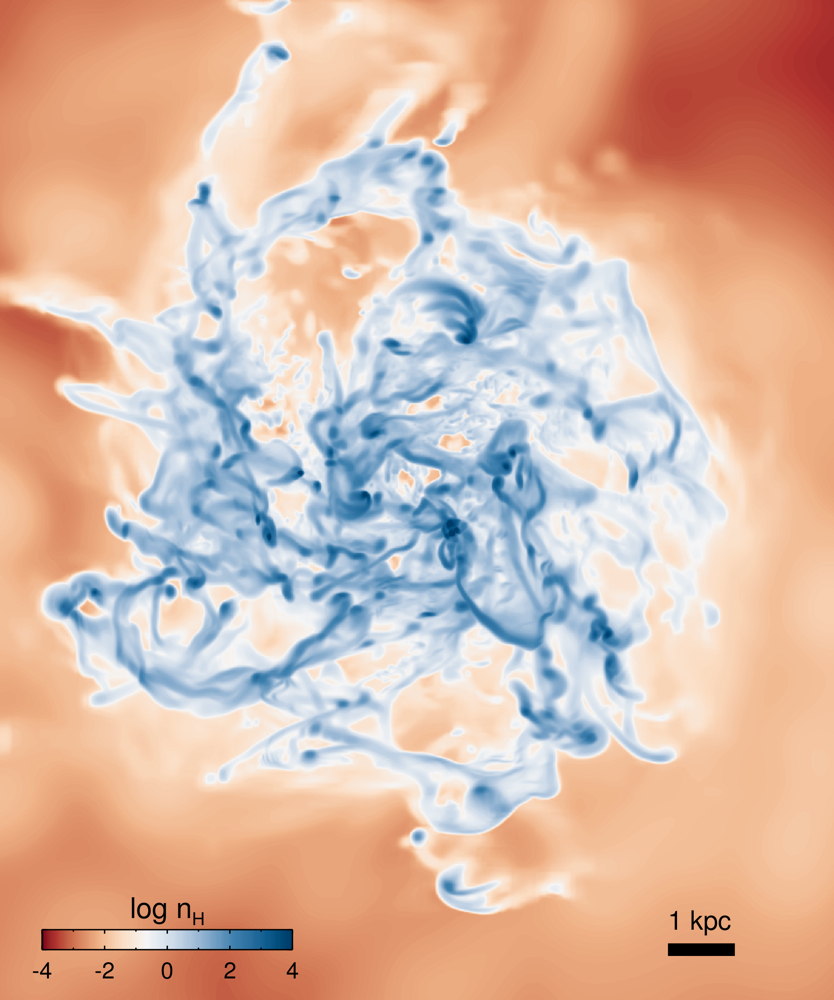
According to the Big Bang theory—the standard cosmological model for the early development of the universe—the very early cosmos was devoid of stars, galaxies, or any other structures. Astronomers can detect faint radiation from that time, known as cosmic microwave background, using radio telescopes.
With space-based observatories such as NASA's Wilkinson Microwave Anisotropy Probe (WMAP), scientists have measured tiny temperature fluctuations in the cosmic microwave background from as early as 380,000 years after the Big Bang. After hundreds of millions of years, they theorize, gravity pulled together enough dark matter and gas around these fluctuations to form clumps that eventually became the first galaxies.
To understand how the cosmos evolved from these primordial clumps into today's highly structured universe, nearly 14 billion years later, researchers are running complex hydrodynamic simulations that begin with these initial early conditions and predict what happens as galaxies form and evolve through time.
Virtual Experiments using Supercomputers
"All of the basic laws of physics that we've learned here on Earth can be applied at cosmological scales," explained Renyue Cen, astrophysicist at Princeton University and principal investigator of the galaxy simulation project. "This enables us to learn how the universe works. But because we cannot contain galaxy-scale experiments in the lab, we do virtual experiments with simulations, using NASA supercomputers," Cen said.

Modeling galaxy formation is extremely complex. A wide range of astrophysical phenomena, scales, and interactions must be incorporated into the numerical simulations, requiring vast computing resources. Fortunately, the Pleiades and Endeavour supercomputers, located at the NASA Advanced Supercomputing (NAS) facility at Ames Research Center, are up to the task.
"Pleiades and Endeavour are complementary," said Cen. "We use Pleiades to run the simulations, which can take several months to complete. Then, Endeavour's shared-memory architecture provides an ideal platform to extract meaning from the resulting terabytes of data, making data mining very easy for us."
The hydrodynamic simulations run on Pleiades, called "Large-scale Adaptive-mesh-refinement Omniscient Zoom-In" (LAOZI) simulations—named for Laozi, the ancient Chinese philosopher and cosmologist—represent the current state-of-the-art in galactic modeling. With the LAOZI simulations, researchers can, for the first time, follow the formation and evolution of thousands of galaxies simultaneously, providing an unprecedented opportunity to gain deep understanding of the fundamental mechanisms underlying galaxy formation and cosmological phenomena.
Why Do Blue Galaxies Turn Red?
The LAOZI simulation results closely mirror what astronomers observe today using highly capable tools such as the Hubble Space Telescope. This validation gives the researchers confidence in the simulations' capability to help answer longstanding questions about the formation, evolution, and death of galaxies.
Researchers can, for the first time, follow the formation and evolution of thousands of galaxies simultaneously.
For example, astrophysicists have long wondered why some galaxies change color from blue to red. A galaxy's intrinsic color, which is observable with telescopes, indicates its stage of evolutionary growth—a blue galaxy is actively spawning new stars, while a red galaxy is slowly fading, its stars dying out. Galaxies need a lot of gas in order to form stars; if the gas supply is cut off, new stars cannot be produced. Why does this happen in some galaxies and not others? How long does it take for a blue galaxy to turn red?
The LAOZI simulations suggest that the environment surrounding a galaxy may be responsible for its transition from blue to red. In some very hot places in the universe—with temperatures up to 10 million kelvins—stars cannot form, because extremely hot gas cannot condense. When a galaxy runs into this type of environment, according to the simulations, the high temperatures cut off its gas supply, rendering it incapable of producing new stars and turning the galaxy red.
A Surprising Prediction
The most recent simulations completed by Cen's team have produced a surprising prediction. According to the data, the earliest galaxies—which came into existence just 600–700 million years after the Big Bang—were remarkably mature. They likely contained metals and dust and usually formed stars at a high rate, and would therefore appear extremely luminous on the far infrared end of the spectrum. This finding is contrary to the science community's conventional expectation that the earliest galaxies would be mostly free of dust and therefore relatively dim in the far infrared.
Over the next few years, new observations from the Atacama Large Millimeter Array, an astronomical interferometer designed to detect faraway objects in the far infrared, and the infrared-optimized James Webb Space Telescope, scheduled for launch in 2018, will enable astrophysicists to verify the team's predictions.
Further analysis of these and subsequent LAOZI simulations will provide more clues to help researchers answer outstanding astrophysics questions, such as how supernovae explode and project heavy elements into the interstellar medium and intergalactic space. Future investigations into galaxy formation and evolution may even shed some light on the mystery of dark matter and energy, enabling researchers to fine-tune the standard cosmological model and further our ancient quest to understand the nature of existence.
—Michelle Moyer, NASA Ames Research Center
