
NASA Earth Exchange: Meet Up in the NEX World
Take one of the world’s fastest supercomputers, add hundreds of terabytes of Earth science data, mix in state-of-the art software tools, and blend with an array of international experts. The result: NASA Earth Exchange (NEX), a complete collaborative workspace for engaging and enabling the extended Earth science community.
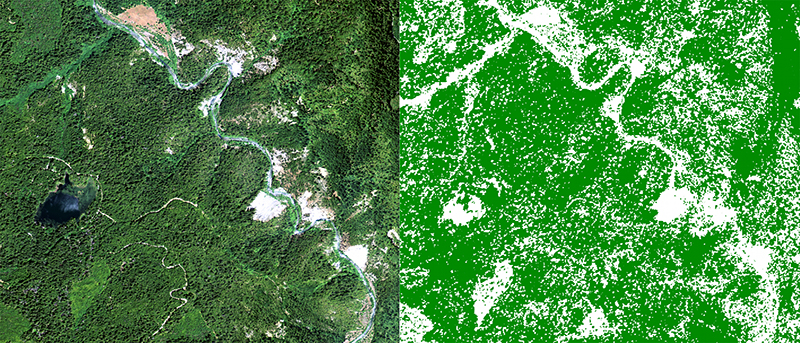
NEX, a key project within the NASA Advanced Supercomputing (NAS) Division at Ames Research Center, offers a unique capability to share knowledge, research, and tools to address global environmental challenges. The three tiered components of the NEX workspace architecture—a recently updated web portal for scientific collaboration and knowledge sharing, a research sandbox with useful tools, datasets, and publications, and high-performance computers for running data analysis and modeling and simulation on a large scale—are accessible to a variety of Earth scientists from universities, government, industry, and non-profits around the world.
“The idea is to give scientists a gateway to all the technologies they need to join forces, make new discoveries, and share knowledge gained to fast-track our understanding of the planet we live on,” said Dr. Ramakrishna Nemani, NEX principal scientist from the NAS Division.
Easy Access to NEX Resources
Through the newly expanded NEX web portal, Earth science community users have easy access to NEX’s trove of cross-disciplinary information, where they can explore what other researchers are studying and build their science social networks through shared abstracts and papers.
NEX members who would benefit from using supercomputing resources for large-scale projects addressing NASA climate and environmental change research can also apply for access to the Pleiades supercomputer—currently ranked among the top 10 most powerful systems in the U.S. Potential users undergo a formal application and review process, and must meet federal security requirements in order to use Pleiades and mass storage resources at the NAS facility. These users can take advantage of the rich collection of large Earth science datasets, tools, and modeling algorithms to explore and analyze satellite data, run Earth system modeling codes, and quickly share results with the team and the NEX community.
Adding to the mix of NEX resources is the new OpenNEX environment (see sidebar at right, “Earth Science Data in the Cloud”), which currently includes workshops and recorded video of past lectures. In the near future, OpenNEX will provide virtual labs hosted by NASA and Amazon. The labs are an experiment in providing ready-to-use NASA data and knowledge outside of NASA’s computing infrastructure, minimizing impacts to NASA while enhancing community participation.
Real-World Results
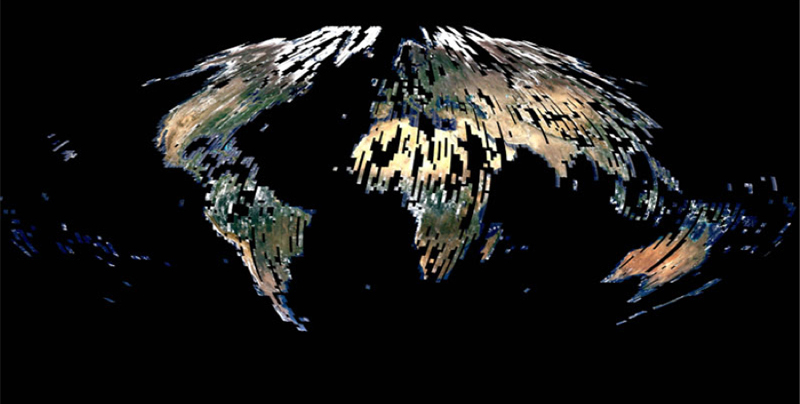
One example of real-world results facilitated through the use of NEX resources is the NASA funded Web-enabled Landsat Data (WELD), a joint NASA-U.S. Geological Survey (USGS) project that provides free access to composited Landsat mosaics of the conterminous United States and Alaska. Under this project, a science team at South Dakota State University has generated ten years of 30-meter U.S. Landsat derived data products for use by the Earth science user community.
“NEX is an amazing resource, and provides the opportunity to ‘bring the application to the data’ in order to undertake petascale data processing,” said David Roy, professor and co-chair of the joint NASA-U.S. Geological Survey (USGS) Landsat science team. “The combination of high-performance computing, a dedicated satellite archive, and the ability to rapidly process and reprocess very large-volume satellite data enables us to generate a consistent, global Landsat product history.”
In response to the WELD user community’s enthusiastic request for long-term global coverage products, Roy’s team is now using NEX resources to generate monthly science results for any terrestrial non-Antarctic location, for 6 three-year epochs spaced from 1985 to 2010. The results will complement existing WELD products, and will be used by the community to document anthropogenic and natural changes at scales from local to global.
Another example of promising real-world results enabled by the NEX environment involves the Amazon rainforest, which has gone through two extreme droughts since 2005. When NASA scientists studied the first drought, it took 18 months to process and analyze all the data. In sharp contrast, scientists completed an analysis of the 2010 drought in just one month by using NEX workflow capabilities and Pleiades. This quick analysis led to further investigations that revealed widespread reductions in the health of forest vegetation in the Amazon basin.
With its enhanced web portal and new features, NEX’s state-of-the-art environment for scientific collaboration will help NASA and its partners in the Earth science community more accurately pinpoint sources of change in the Earth system, accelerate our ability to identify and predict emerging patterns, and show us ways to respond and adapt to these changes that could improve life on our planet for generations to come.
—Jill Dunbar, NASA Ames Research Center
This article was updated on January 22, 2014. The original version first appeared as, "NASA Earth Exchange Joins NRP Partnership," in the NRP Post on September 10, 2012.
