
Giving Rocket Science a Boost
According to a 2008 entry in the Encyclopedia Britannica blog, "it's not rocket science" is distinguished as one of the top 10 most overused and useless expressions in the English language. But as NASA pours both its brainpower and supercomputing power into developing a new heavy-lift Space Launch System (SLS) for human exploration far beyond Earth, expertise in rocket science is exactly what's needed for success.
These high-fidelity CFD models and simulations give engineers ready access to valuable performance data, allowing them to proactively consider complex design factors with even greater acuity as they prepare to build the most powerful rocket in history.
To facilitate this notoriously difficult endeavor, modeling and simulation experts in the NASA Advanced Supercomputing (NAS) Division at Ames Research Center are performing high-fidelity simulations that supply key aerodynamic data to the agency's aerospace engineers. These cutting-edge simulations, run on NASA's Pleiades and Columbia supercomputers, are crucial to streamlining the speed and cost of the SLS design process while also ensuring the highest possible performance and safety standards.
Specialized codes crunch aerodynamic data
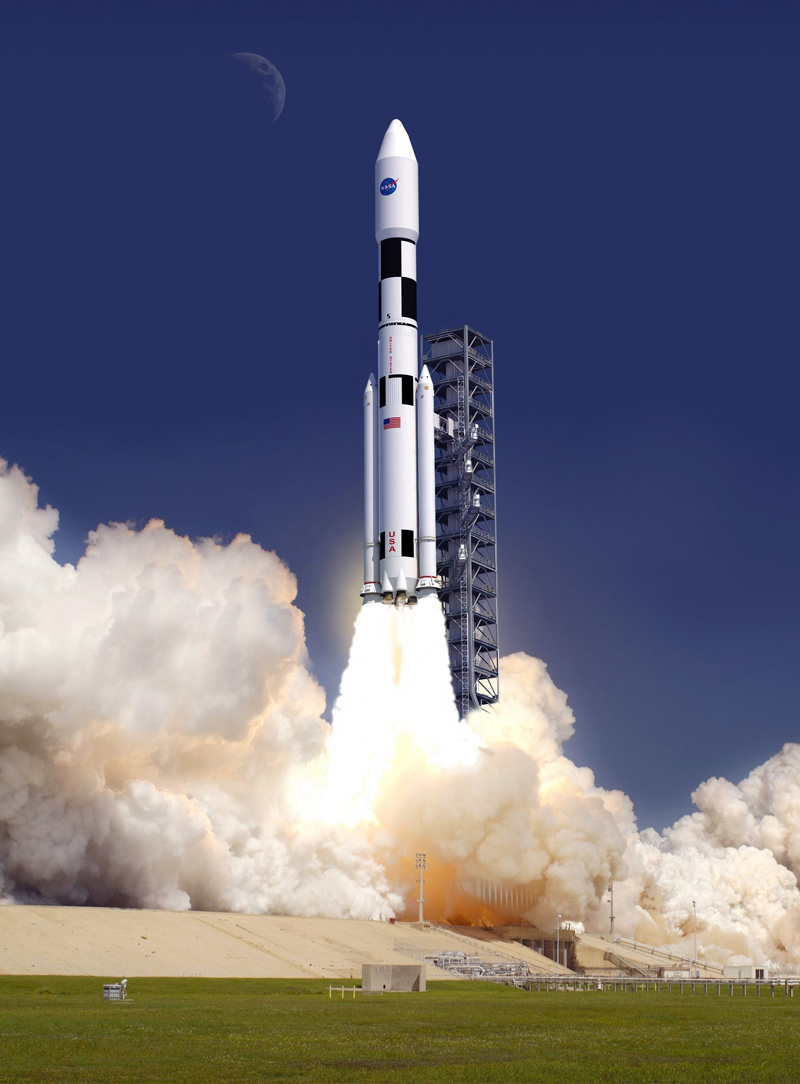
NAS computational fluid dynamics (CFD) experts use specialized, NASA-developed codes to model evolving SLS vehicle designs and compute the detailed aerodynamic flows, forces, and interactions that could affect mission success and safety during launch. Their results supplement limited wind tunnel data and enable more conditions and designs to be assessed—all at a fraction of the cost and time that would be required to obtain data through testing alone.
"Results from our analyses enable designers and engineers to optimize the vehicle's shape and launch trajectory for better performance," said Cetin Kiris, chief of the NAS Applied Modeling and Simulation Branch. "They are also used to assess the amount of structural stress, heating, and vibrations that the vehicle will encounter during launch."
Key design areas that CFD results will impact include: placement of feed lines, attachments, rings, and flanges; layout of the main engines; and the size of the Solid Rocket Booster (SRB) separation motors. Inside the SRBs, the structure and positioning of vents between the fuel tanks will depend on detailed CFD analyses of the aerodynamic forces that the SRBs experience during separation.
Supercomputing technology speeds design cycles
During the early design period, focus is placed on the stability and control of the SLS during ascent, and on maintaining structural integrity throughout the mission. CFD simulations have contributed to critical, early design decisions, before experimental or flight data could be obtained. For example, CFD analyses helped to compare the alternate architectures that were being considered during the vehicle's preliminary concept and initial design phases, and are currently being used to assess the next round of crew and cargo launch design variations.
"At the beginning of each design cycle, CFD simulations quickly provide the aerodynamic data needed to support further trajectory adjustments, structural analyses, and other key studies," explained Kiris. The fast turnaround of the CFD data—which can often be generated within just a few days, thanks to NAS supercomputers and modeling expertise—greatly expedites the design cycle process and will be pivotal to meeting the agency's ambitious goal of launching the first SLS flight around the end of 2017.
Comprehensive models incorporate the entire launch environment
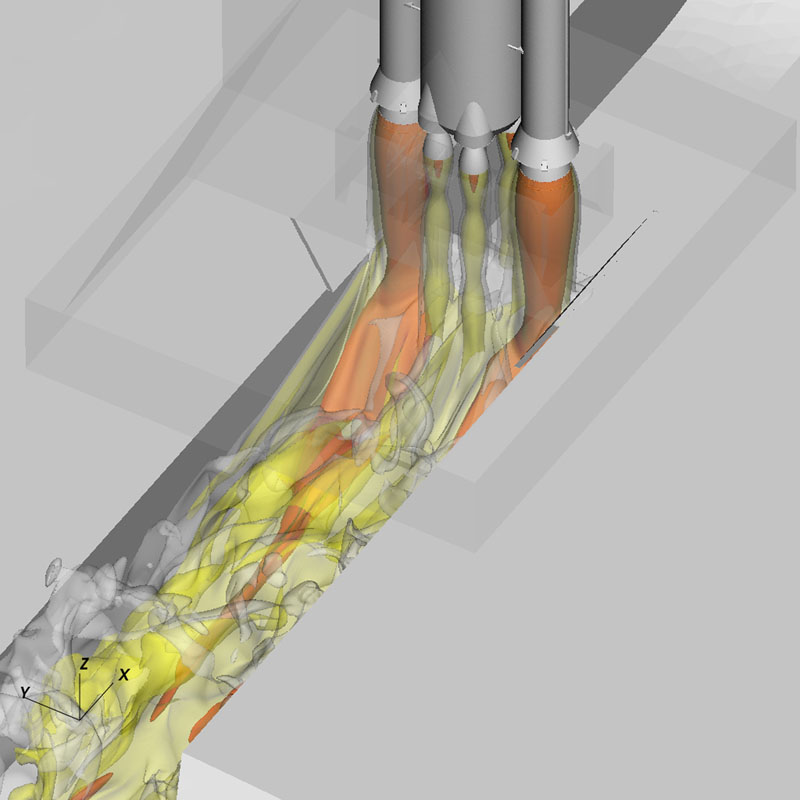
As the SLS design continues to mature, increasingly high-fidelity simulations are used to assess more detailed design features and more complex aerodynamic phenomena, such as the effects of the vehicle's various rocket plumes and other launch environment conditions.
The NAS CFD team laid significant groundwork for analyzing these challenging problems early on by refining CFD codes, modeling techniques, and post-processing tools, and by establishing best practices for simulating heavy-lift launch vehicle and launch environments. To date, the team has run thousands of simulations, each using several hundred cores on the Pleiades supercomputer and producing many terabytes of data.
Comprehensive simulations based on models of the vehicle, platform, and flame trench configurations are contributing to the design of NASA's 21st Century Launch Complex, helping to ensure that the new launch environment at Kennedy Space Center can handle the extreme thrusts that will be generated by the SLS.
These high-fidelity CFD models and simulations give engineers ready access to valuable performance data, allowing them to proactively consider complex design factors with even greater acuity as they prepare to build the most powerful rocket in history. While rocket science may always represent the epitome of difficulty and complexity, NASA's powerful supercomputers and simulation capabilities are helping to make the infamous discipline a little less daunting, enabling precision-engineering more easily than ever before.
—Lorien Wheeler and Michelle Moyer, NASA Ames Research Center
