
Optimization Experts Improve Efficiency of the National Combustion Code on Pleiades
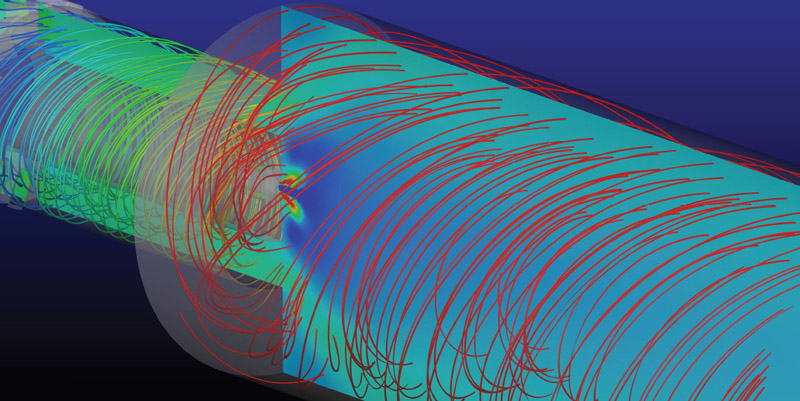
Software engineers from the NASA Advanced Supercomputing (NAS) Division, with assistance from counterparts at NASA Glenn Research Center, have improved the parallel performance of the National Combustion Code (NCC) by up to 60 percent when run on the Pleiades supercomputer.
NCC, an unstructured-grid Navier-Stokes computational fluid dynamics code developed at NASA Glenn, is widely used within NASA to develop and validate new physical models of turbulence, chemistry, spray, and turbulence-chemistry and turbulence-spray interactions in gas turbines and engines. The code takes advantage of solid modeling and automated meshing of complex 3D structures. Speeding up the computational performance of NCC enables agency scientists and engineers to analyze and solve more complex aerodynamics and problems in combustion related components.
To obtain this large performance increase, NAS engineers incorporated a new grid partitioning option called the Recursive Coordinate Bisection Method (RCB) into NCC. The RCB method, developed at Sandia National Laboratory, optimizes grid partitioning based on information about the cells, such as their computational load and proximity to each other.
RCB provides an alternate to the METIS 4.0.1 software previously used with NCC, whose parallel performance would quickly deteriorate as the number of processors was increased for simulations including liquid spray, limiting its performance on the Pleiades supercomputer. Two out of three turbulent spray combustion test cases representing typical flame tube experiments showed that the RCB partitioning method improved NCC’s performance by 60 percent in some cases, when compared to the original METIS method.
Experience gained through the RCB implementation provides a solid foundation for the next phase of NCC optimization in which NAS experts will begin using the more complex grid partitioning method ParMETIS to minimize both communication and load imbalance across the computation.
So that users can benefit from the improved parallel performance, the RCB method will be added to the next revision of the NCC software package, schedule for release in August 2012.
