
NAS Produces Animations of Dark Matter for Planetarium Shows
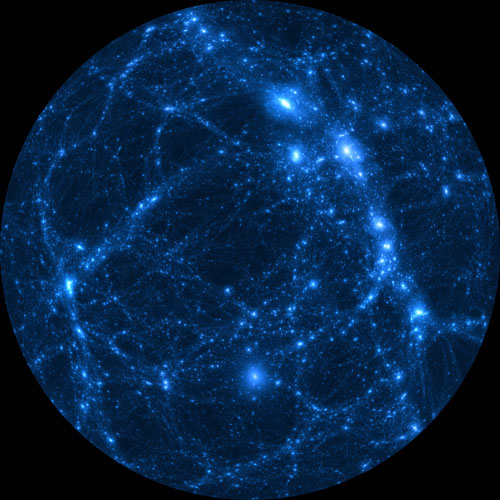
Visualization experts in the NASA Advanced Supercomputing (NAS) Division have generated astronomically large-scale, high-resolution animations of dark matter in Earth's galactic neighborhood. The animations will be featured in upcoming planetarium shows offering science and education information for the public.
The NAS website received over 25,000 visits via IPv6 during the daylong event, giving NASA high-end computing information expanded visibility to the public, and demonstrating NASA's readiness-level to implement IPv6 agency-wide by the end of 2012, as mandated by the federal government.
Using NAS's powerful hyperwall-2 visualization system and the massive data management capacity of the Pleiades supercomputer, Henze rendered an incredible amount of data to produce 26,000 high-resolution frames, totaling 740 gigapixels—that's 740 billion pixels—and 4.5 terabytes of uncompressed visualization data. Making all these images required streaming 422 terabytes (just under half a petabyte) of data from Pleiades' Lustre filesystem to the hyperwall-2 over InfiniBand.
Henze also fine-tuned several key rendering elements to bring the dark matter's features to life, including highlighting hard-to-distinguish filamentary structures, improving the depth of field of the images, and eliminating "popping" artifacts from camera rotations.
The animations will be shown at the newly renovated Adler Planetarium's Grainger Sky Theater in Chicago, opening July 8th. They have also been featured at the California Academy of Sciences' Morrison Planetarium in San Francisco, as part of the Benjamin Dean astronomy lecture series.
The Constrained Local Universe Simulations (CLUES) of dark matter simulations were performed by Stefan Gottloeber, Astrophysical Institute Potsdam, and Anatoly Klypin, New Mexico State University.
