Liutex – The Past, Current, and Future
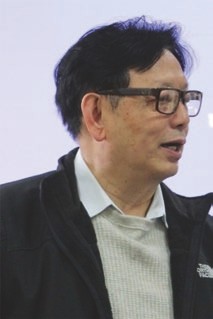
Speaker: Chaoqun Liu, University of Texas at Arlington
Presentation
Seminar Slide Deck (PDF-12.1MB)
Abstract
Liutex is a rigorous and mathematical definition of local fluid rotation or vortex, given in 2018 for the first time in history. Liutex is a vector. Liutex direction is the local fluid rotation axis which is defined by the eigenvector of the velocity gradient matrix. Liutex magnitude is twice the local angular rotation speed. The naturally observed vortex core is the concentration of Liutex lines or local maxima of Liutex. Note that natural vortex cores are not vorticity tubes or local maxima of vorticity as defined by almost all fluid dynamics textbooks and countless research papers, which is a historical misunderstanding for almost two centuries. Discovery of Liutex is a groundbreaking work that opens a new era to conduct quantified research on vortex science and turbulence. This is a revolutionary advance in fluid dynamics history. Helmholtz defined vortex as vorticity tubes in 1858, which is classified as the first generation of vortex definition and identification or G1. During the past four decades, many vortex identification criteria including Q, Delta, Lambda 2 and Lambda Ci have been developed, based on the eigenvalues of the velocity gradient tensor matrix, which is classified as the second generation or G2. However, all G2 are scalars but vortex is a vector, and they are strongly dependent on the so-called threshold which is arbitrary and empirical. More seriously, they are all contaminated by shears to different degrees. Therefore, they cannot capture the right vortex structures. After Liutex was born in 2018, many Liutex-based vortex identification methods have been developed and reported, which is called the third generation of vortex identification methods or G3. Among them, the most popular methods are Liutex iso-surface, Liutex-Omega (threshold insensitive), Liutex-core-line (threshold-free and unique), and Objective Liutex, (coordinate system free). According to the Liutex theory, vorticity should be decomposed to a rotational Liutex, and non-rotational shear and velocity gradient tensor should be decomposed to shear, stretching and rotation to replace the classical Helmholtz (Cauchy-Stokes) velocity decomposition. The Liutex similarity in the dissipation sub-region in boundary layers has been found, which could be the foundation for Liutex-based subgrid model for large eddy simulation (LES). Since 2018, thousands of citations in applications of Liutex have been reported and six Liutex books have been published by professional publishers. Six Liutex short courses and workshops have been held. Since the vortex is omnipresent in the universe, the introduction of Liutex will benefit researchers in almost all fluid-related research areas including aerodynamics, hydrodynamics, meteorology, bio flow, space science, etc. Collaborations on hurricanes and tornadoes, sun storms, respiratory flow have been initiated. Two NSF EAGER grants, #2300052 and # 2422573 have been awarded to the UTA Team.
Biography