High-Fidelity Numerical Simulations of Hypersonic High-Enthalpy Flows
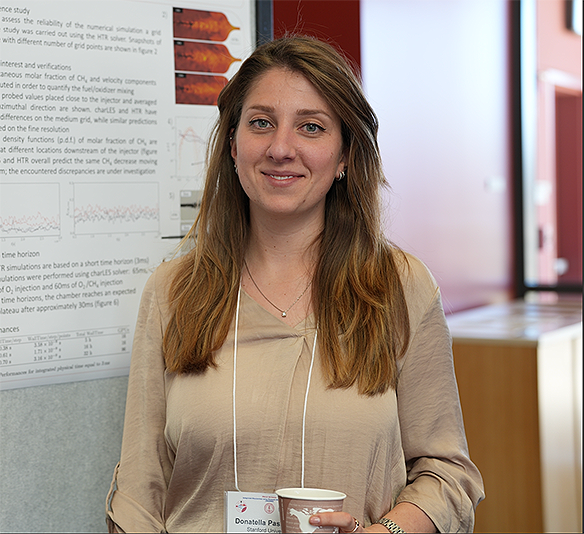
Speaker: Donatella Passiatore, Stanford University
Presentation
Seminar Slide Deck (PDF-10.8MB)
Abstract
High-enthalpy flows are encountered in many fields related to the aerospace industry. These flows are characterized by the presence of thermodynamic processes having a major influence on the performance of vehicles flying at hypersonic speeds, such as gas dissociation, vibrational relaxation, surface ablation or ionization. The rate at which these different processes evolve is highly dependent on the local thermodynamic conditions and can be of the same order of the natural timescales of the flow, resulting in a nonequilibrium state. The overall picture is even further complicated when turbulence comes into play, because of the wide range of spatial and temporal scales involved. Performing numerical simulations of high-enthalpy turbulent flows is an extremely challenging task that requires the use of appropriate numerical methods, which must be properly designed to meet the simultaneous needs of ensuring sufficient numerical robustness and accurate representation of the flow scales to be solved. In this regard, high-fidelity simulations can further help to provide accurate prediction of the two-way coupling of wall-bounded compressible turbulence and thermochemical processes triggered by the high temperature at stake. Multiple turbulent wall-bounded configurations are investigated in this work, with the final aim of studying the effect of finite-rate chemistry and vibrational relaxation on highly compressible turbulent flows. To conclude, insights on turbulence closure modeling in the context of lower-fidelity simulations of high-enthalpy flows are provided.
Acknowledgments: Luca Sciacovelli, Paola Cinnella, Giuseppe Pascazio
Biography