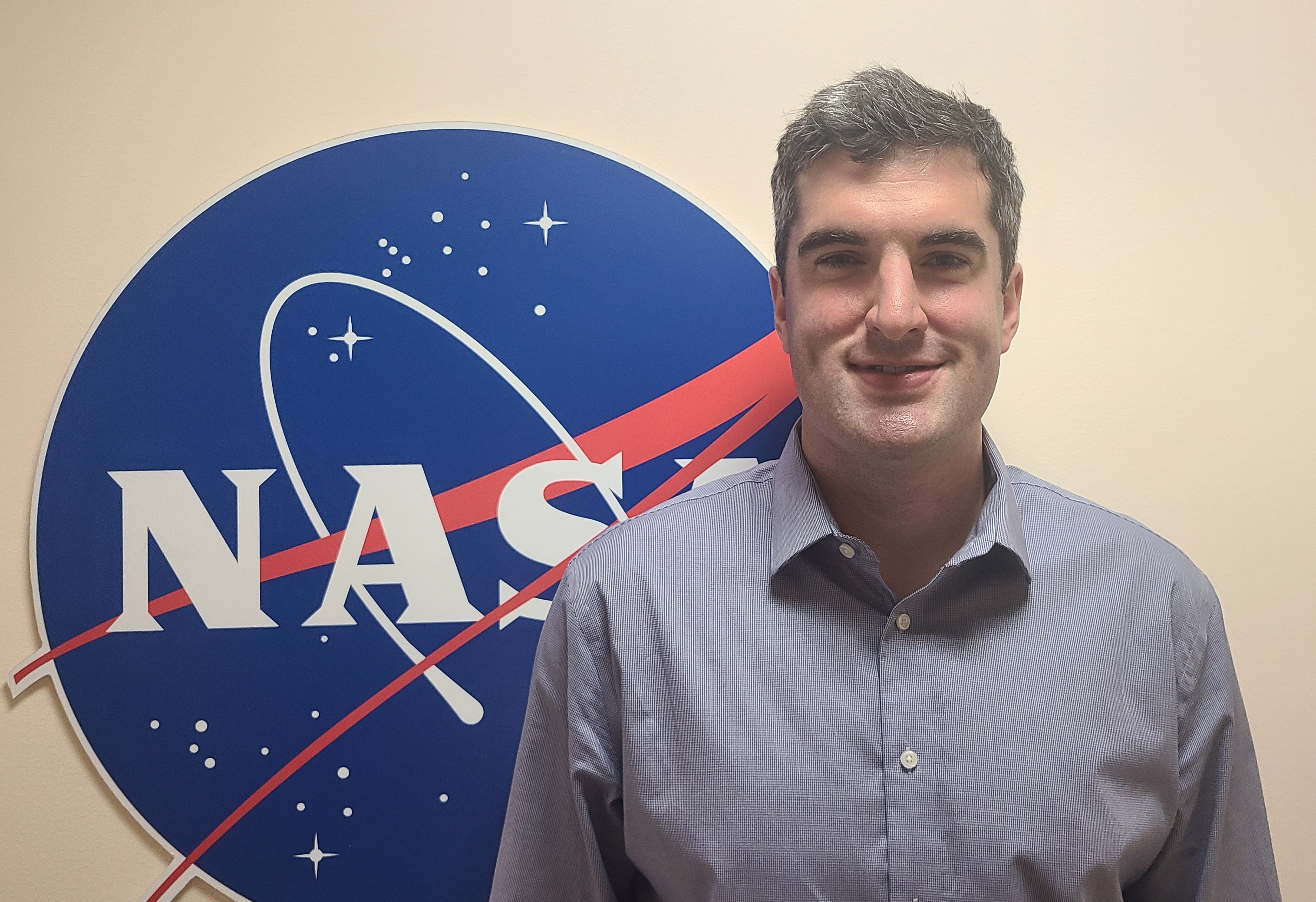
Predicting High-Lift Aerodynamics on NASA Common Research Model - Part II: Delayed Detached Eddy Simulations
Speaker: Oliver Browne, Science and Technology Corporation, NASA Ames Research Center
Presentation
Seminar Slide Deck (PDF-13.6MB)
Abstract
An assessment of a Hybrid Reynolds Averaged Navier-Stokes (RANS)/Large Eddy Simulations (LES) {HRLES} approach for CLmax prediction, utilizing the Launch, Ascent, and Vehicle Aerodynamics (LAVA) solver, is presented for the NASA high-Lift Common Research Model (CRM-HL). Both the free air and the wind tunnel configuration of the CRM-HL are investigated, and the results are compared to the QinetiQ wind tunnel experiments and to two other numerical approaches: RANS and Wall-Modeled Large Eddy Simulations (WMLES). For the free-air configuration, HRLES was shown to address some of the known shortcomings in RANS methods and prevent inboard and outboard flow separation particularly in the region of CLmax and post-stall. To achieve these improvements over RANS, LES-appropriate grids and numerical discretizations are required. HRLES predicts a weak pitch break at the highest angle-of-attack due to onset of wing-root corner flow separation whereas the free-air corrected experiment values indicate an occurrence of a much stronger pitch break. The improvements of HRLES over Unsteady RANS approach has been objectively shown by computing a set of solutions with the same grid, same numerics and time-step size and comparing the solutions. It was also found that when applying HRLES to a RANS best practice grid and numerics that the HRLES method significantly underperformed RANS. For the in-tunnel configuration, HRLES showed good agreement with the loads, surface pressure and oil-flow photographs obtained in the experiment. HRLES was able to improve upon the RANS simulations, which showed a sharp loss of lift at the two highest angles-of-attack due to large scale inboard and outboard separation on the wing, by correctly predicting the corner flow separation and showing remarkably close agreement in the flow topologies with the experiment.
Funded by the Transformational Tools and Technologies (T3) project under the NASA Aeronautics Research Mission Directorate's Transformative Aeronautics Concepts Program (TACP).
Biography